


Features 2025.11.23

By Li Guohua
On the midnight street, men and women dressed in finery gather before a vibrantly lit structure, amidst the glittering lights and flowing drinks of the city night. Whether this structure is a bar, a theater, or an art gallery, the artist offers no definitive answer on the canvas. On the street outside, cars continue to arrive steadily, while humanoid figurines emerge at the street corner, making their way from the city’s unknown depths towards this grand gathering. Atop the building, vivid blocks of color shimmer, resembling perhaps neon signs, or perhaps abstract paintings. To those familiar with urban nightlife, this scene might appear utterly mundane. Yet, reimagined and restaged by the artist, this ordinary slice of daily life takes on an uncanny sense of the absurd...
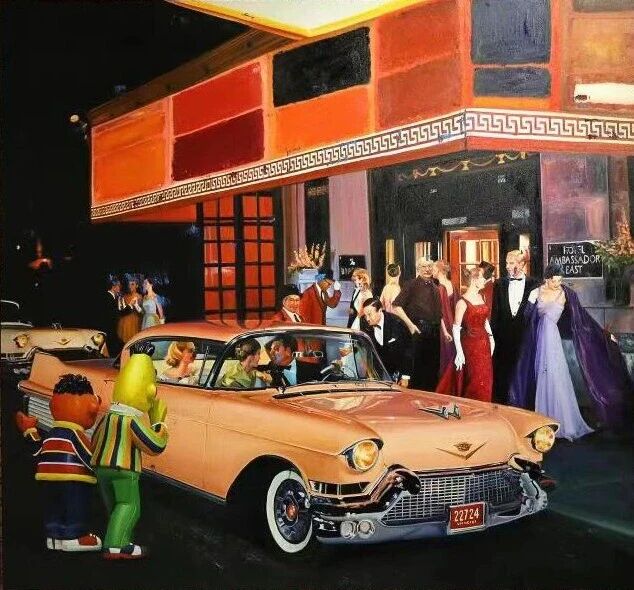
This work was created by artist Zhang Zhaoying between 2021 and 2022. At that time, the pandemic was raging across China, frequently leading to restrictions on the free movement of people. Within this painting titled Life Props – To a Spectacular Color Field Painting Show, the artist conjures an imagined scenario of people flocking to an exhibition of paintings by the American artist Jackson Pollock. The lively scene depicted stands in stark contrast to the reality of the period: people confined to their homes were unable to go out, let alone travel abroad to view exhibitions. In an era of advanced transportation and information, this should have been effortless. Yet, due to the pandemic, it became exceedingly difficult, almost impossible. (Interestingly, however, after the pandemic restrictions thawed, this artwork, like humanity itself, regained the freedom of international movement and was exhibited at Italy's MART Museum of Modern and Contemporary Art of Trento and Rovereto). The artist employs a humorous and romantic imagination to transform an inner desire into a visual reality. Simultaneously, through this contrast with reality, he seems to illuminate how the mundane life we take for granted can, under certain moments and circumstances, morph into an incomprehensible scene of theatrical absurdity. As the "director" of this pictorial absurdist theater, Zhang Zhaoying has demonstrated a profound interest in images imbued with dramatic, staged scenes since his very first engagement with painting.
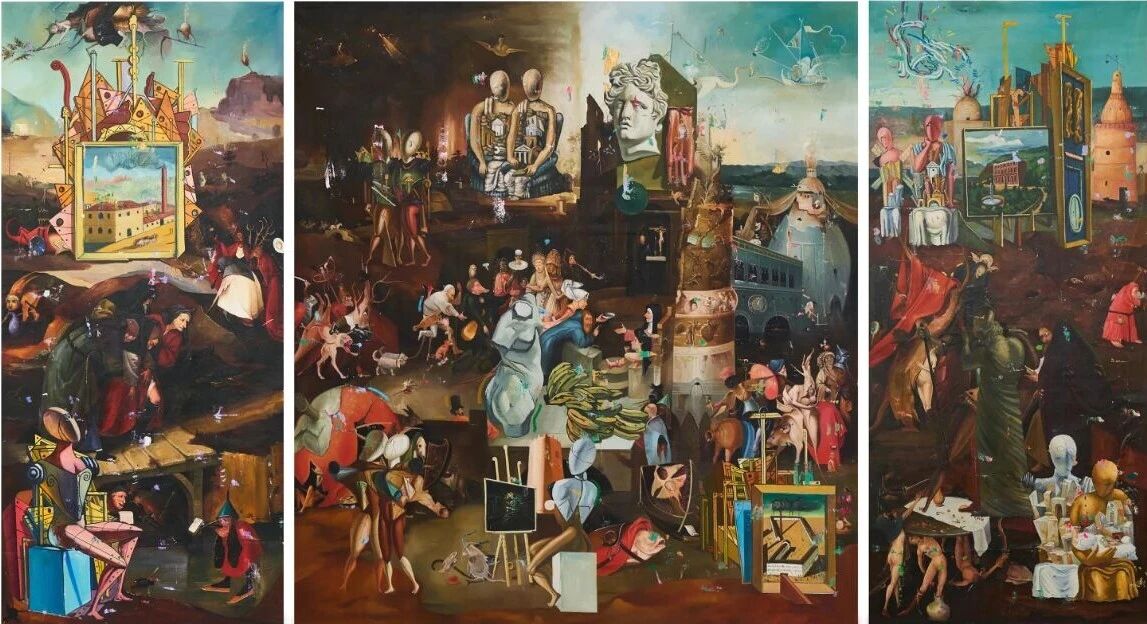
Born in Guangzhou, the artist possesses an innate sensitivity to multiculturalism and the hybridity of life. This cultural DNA, rooted in his birthplace, has profoundly influenced his subsequent career trajectory. After studying in the Oil Painting Department of the Sichuan Fine Arts Institute, he pursued further education in Brussels, Belgium. During his studies abroad, his specialization focused on stage arts and the theater of the absurd. The layering of these backgrounds undoubtedly steered the artist towards painting imbued with a powerful theatrical sensibility.
Of course, his acute perception of the contemporary era is also a crucial reason for the dramatic nature of his work. Globalization, consumerism, social media apps, short-form videos, and AI technology have rendered today's world strikingly different. They have brought about an explosion of information, resulting in an unprecedented phenomenon: images from disparate civilizations, political systems, and visual vocabularies assault our vision like a tsunami. While this inundation brings the visual pleasure of multiculturalism to our eyes, it also generates confusion, especially for visual practitioners. Faced with such an overwhelming, even excessive, abundance of image resources, fundamental questions arise: In what manner should we confront them? Which images can genuinely connect with our creative practice? Which images can represent the psyche of our era? Which images are authentic, and which are false?
These are not easy questions to answer, nor are they light choices to make. Consequently, Zhang Zhaoying has chosen a different path. He does not concentrate on seeking images that are microcosms of society or possess strong representational power. Instead, he adopts a broader and more playful attitude. He transforms himself into a "director." Confronted with a multitude of images, he recombines and re-stages them according to his phased research to express his intentions. Sometimes, he also employs appropriation, directly transposing the images he collects onto the canvas. Therefore, viewers encounter within Zhang Zhaoying's paintings a cast that includes characters from Broadway stage plays in New York, circus performers, artists from art history, and historical celebrities.
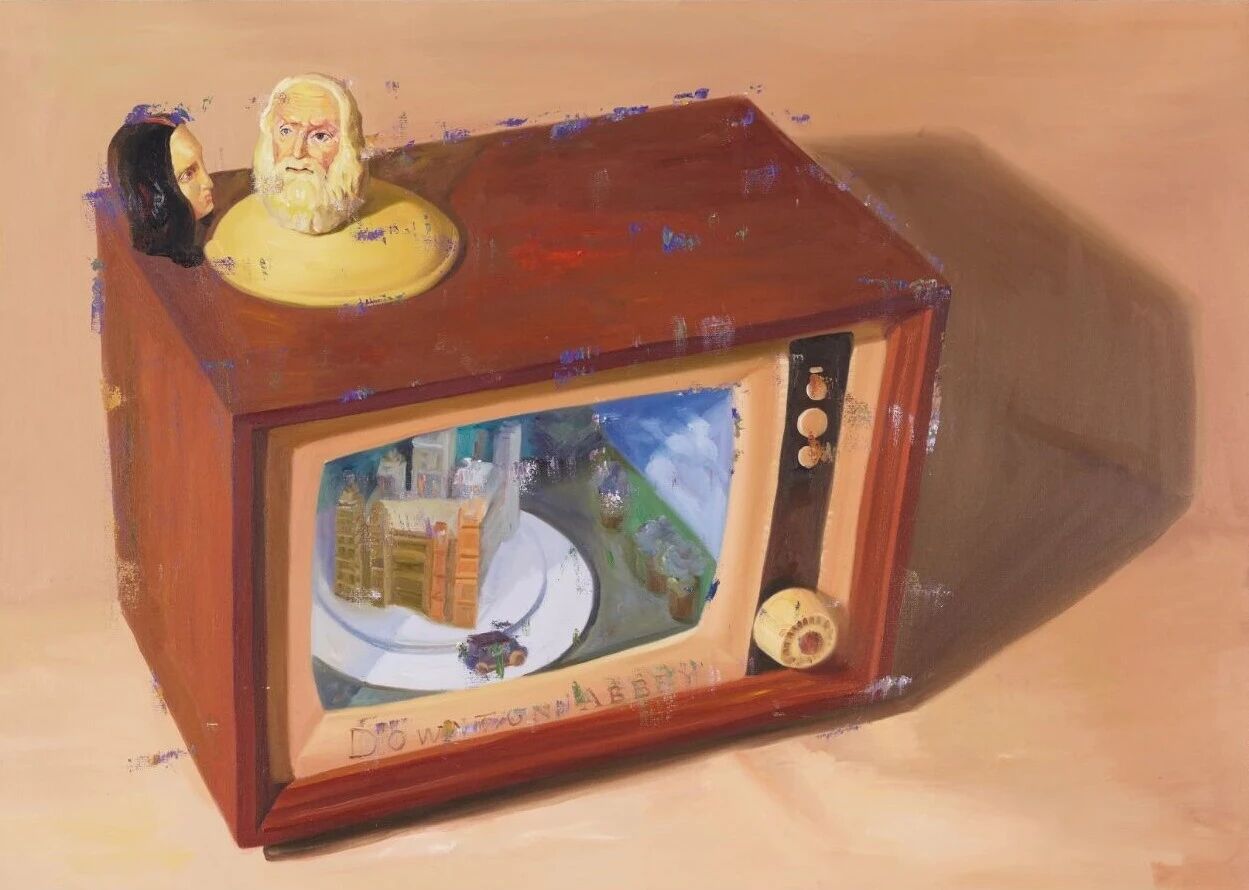 Lifelong Learning – World Themepark – Downton Abbey and Leonardo da Vinci, 2020–2021 Oil on canvas with airbrushed acrylic
Of course, the artist does not aim to be a mere compiler of images or an artist resembling a cabinet of curiosities filled with pictures. His primary intention is rather to construct scenarized worlds or events. He employs these constructions to respond to external changes, to probe the enigmas of contemporary society, and to discover the connections between the individual and the world!
Therefore, across his different series of works, he approaches this exploration from diverse angles: history, religion, economics, philosophy, art history... This multifaceted engagement has given rise to series such as “Lifelong Learning,” “Life Props,” “Factory,” “Themepark,” “Mythology,” “Correspondence,” and more. When we view these series collectively, the images coalesce into distinct “stories.” These “stories” possess a heightened verisimilitude, as if the artist were reconstructing a specific scene. In reality, however, they are largely “theatrical” constructs meticulously devised by the artist for the viewer – elaborately woven “visual traps.”
The artist’s objective is precisely to invite the audience into these stories, to experience his thoughts, observations, and feelings. Through this engagement, although the artist refrains from presenting explicit viewpoints or definitive answers within his work, he prompts the audience to re-examine and reconsider those things we once took for granted as certain: whether it be religion, news, or the historical images we firmly believed in – are they truly “authentic” existences, or are they part of a world of lies meticulously designed and orchestrated for us by others!
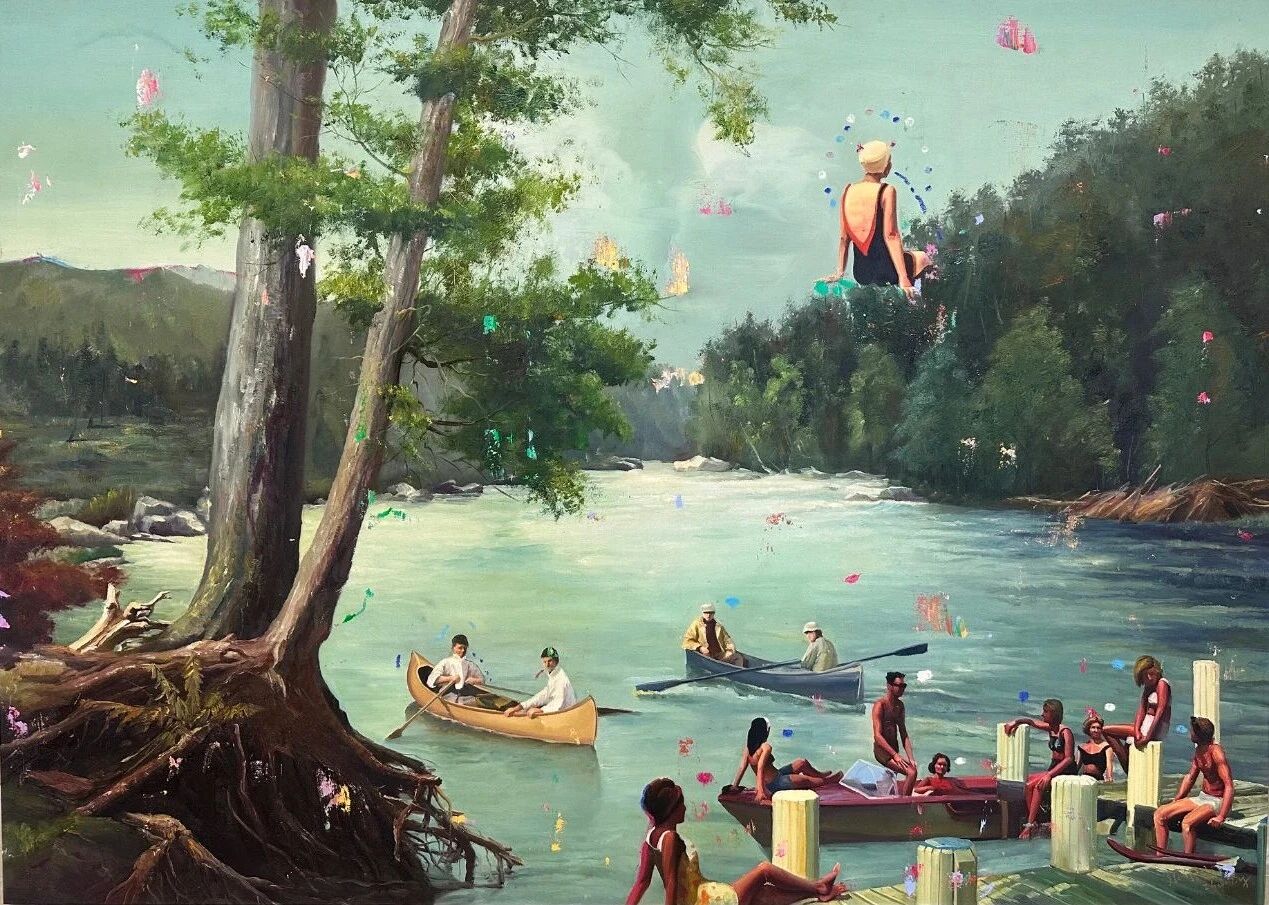
Through all of this, we can also discern that Zhang Zhaoying’s painting poses a crucial question: how, while acknowledging the existing rules of societal operation, can one employ the traditional medium of painting to present the independent thinking of the individual within today’s complex world? Moreover, although he does not resist the influence of technology and new materials on artistic creation – indeed, he has produced many installations and video works – his approach to painting and his utilization of imagery demonstrate that painting can still confront the challenges posed by technological advancements like AI. After all, those high technologies, devoid of the weight of flesh, lacking the sensation of growth, incapable of understanding death and birth, and without the experience of life’s fragility, are still unable to replace the artist’s mind and hand in directly conveying the rich, mutable, and nuanced emotional history of humankind.
Zhang Zhaoying’s painting also reveals significant characteristics of post-2000 Chinese contemporary painting. On one hand, grand narratives and collective perspectives have largely vanished from the work of young artists born in the 1980s and 90s; mannerism or regionally defined artistic phenomena are also gradually being abandoned by this generation. They pursue their creative practice within a more personalized linguistic world and a globalized intellectual horizon. Just as the churches, entertainment venues, games, KTVs, letters, soap operas, and art history references that appear in Zhang Zhaoying’s paintings know no geographical boundaries or nationality, figures as temporally and spatially disparate as Marilyn Monroe, Qi Baishi, and Dalí are frequently juxtaposed by the artist within the same pictorial space. The century-long debate over Eastern versus Western culture, which once preoccupied the art world, has become largely irrelevant in the eyes of these young artists. What truly concerns them is how to use painting to respond to this richly diverse world and express their authentic selves! The boundaries of method and cultural systems have ceased to matter.
Of course, their painting still faces numerous challenges. Beyond the constant onslaught of technology and new materials, the worldly realities constructed by money and power are an inescapable part of their existence. However, just as Zhang Zhaoying continuously introduces new ideas and new stories within his canvases, we believe that sensitivity to the immediacy of lived experience and the vibrancy of contemporary life will empower these young artists to break through the barriers and forge new art history!


