


Features 2025.12.01

By Lin Shuchuan
The "blind spot," as commonly understood, refers to the area beyond the reach of our vision. This phenomenon stems from two conditions: inadvertent neglect or intentional concealment. We must ask: what does our vision tend to overlook, and what does the object of our gaze conceal?
When we contextualize the "blind spot" within the realm of painting, we find that when confronting a work, the physiological reaction triggered by our vision is undeniable. Since we are facing the work directly, where then does the significance of the "blind spot" lie? Artists create works, and these works face an audience. However, the relationship between creation and viewing rarely achieves a true alignment—or perhaps, such alignment is fundamentally unnecessary. Artists produce a visual result, hoping that the majority of viewers—even those without any specific knowledge background or reading experience—can derive some form of satisfaction, whether physiological or intellectual.
To intentionally obstruct the path of viewing while simultaneously expecting a beautiful outcome co-created by the audience is a form of "rogue logic." Yet, this paradox is precisely where the significance of discussing the "blind spot" resides.
In contemporary painting, there is an excess of "hard" elements: a painting is expected to tell a story, discuss philosophy, or run back and forth under the heavy burden of art history. Conversely, there is a scarcity of "soft" elements: those that confront vulnerability, expose the process, and acknowledge the banal, the quotidian, the random, the non-empirical, or the meaningless.
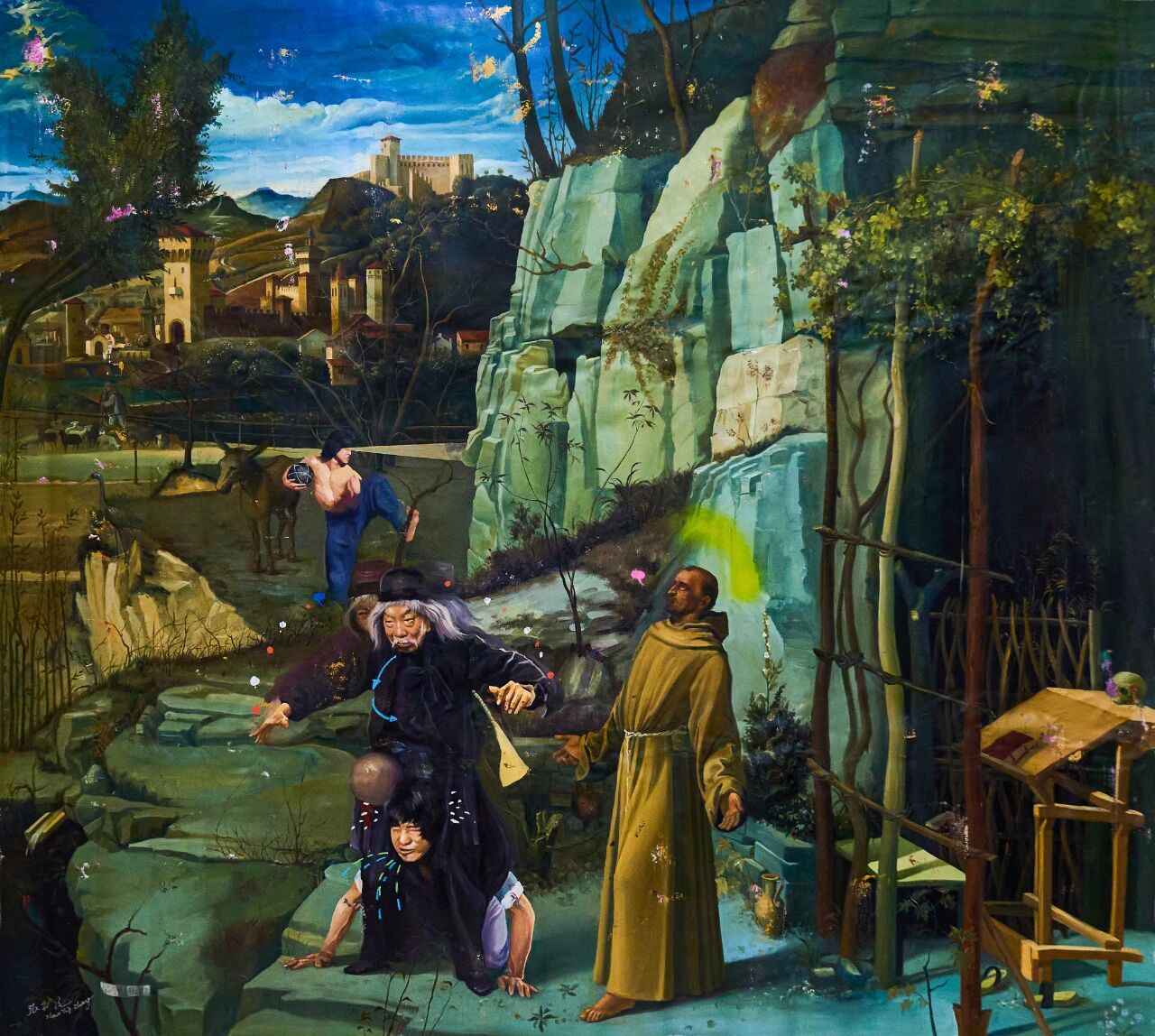 Oriental Tales—Drunk Monkey,2024-2025,Oil on canvas,200×180 cm
Returning to Zhang Zhaoying's practice, his titles—referencing novels, letters, theater, studies, soap operas, history, and art history—repeatedly underscore and hint at a trajectory of thought rooted in his personal daily life.
When using a computer, we typically place current and important files on the desktop to facilitate a systematic and orderly workflow. Zhang Zhaoying's approach, however, resembles a unique "Recycle Bin" methodology. It involves the "undigested deletion" of quotidian visual scenes, blurred life experiences, fragmented internet debris, and unsystematic textual language.
What is reconstructed from this process is a personal style that is quintessentially Zhang Zhaoying: possessed of a strong "second-hand" aesthetic, soap-operatic, carrying a "Guangpu" (Cantonese-Mandarin) accent, and flavored with a Westernized "hamburger" taste.
In the eyes of critics, Zhang Zhaoying's artistic processing is often categorized as a form of "theatricality," where the artist's painterly touch and imagination are rehearsed and staged. Zhang Zhaoying's touch requires no elaboration; it is the sole vital asset upon which every painter relies for survival. Imaginations differ, and the ability to translate that imagination into imagery through one's touch varies from artist to artist.
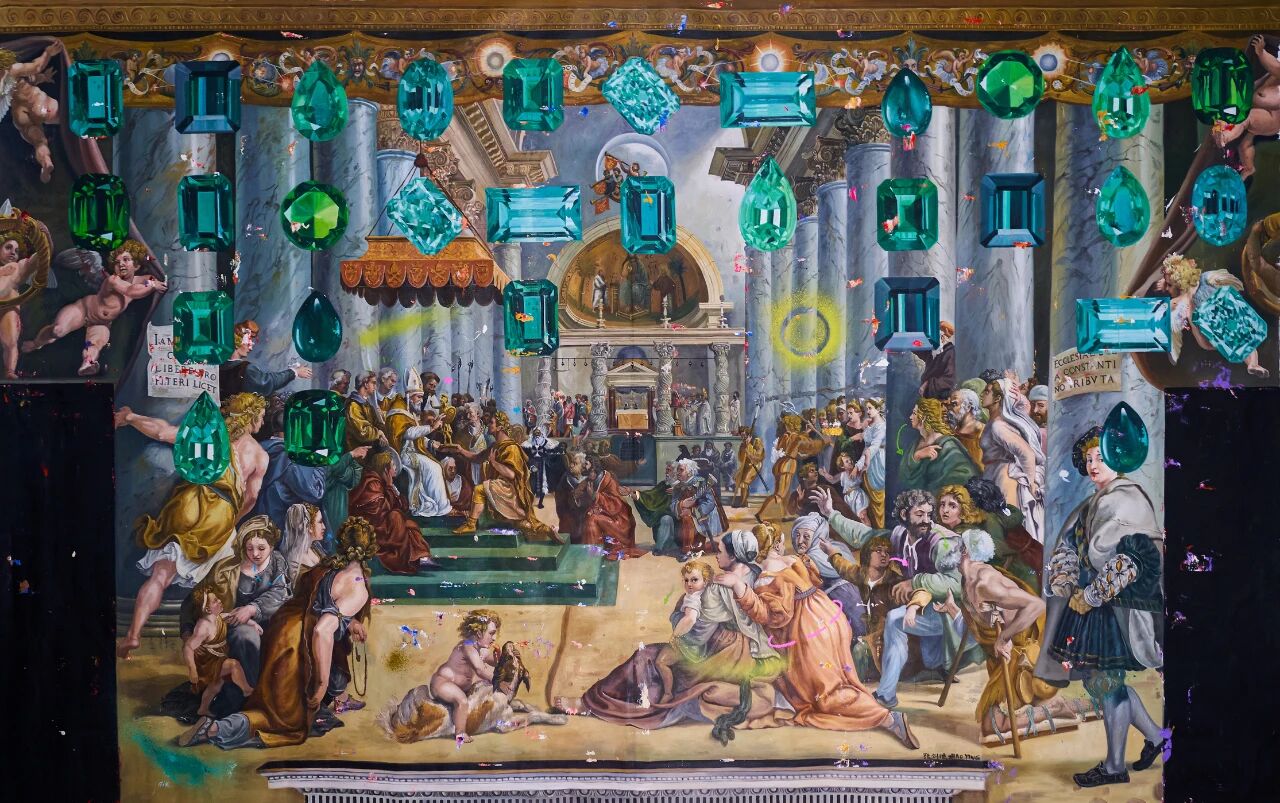 Oriental Tales—Peacock Green,2024-2025,Oil on canvas,237×150 cm
"Theater" thus becomes a crucial pathway for interpreting Zhang Zhaoying. Echoing the "Cartesian theater," the artist presents images to the audience; the outward gaze of the eye transforms the brain into a multi-sensory theater, within which the viewer, through self-consciousness, undergoes a complex reconstruction of the information released by the artist. Similarly, in Erving Goffman’s dramaturgical theory, society becomes a theater and every individual an actor. Zhang Zhaoying’s paintings construct a similar possibility for fluid change, granting the viewer a sense of participation and the ability to "enter" the image at any moment. The artist appears to become the screenwriter or director orchestrating this entire production. By engaging the audience in this "theater," the work transcends the factual, two-dimensional space and enters a deeper dimension of the imaginative world.
The "blind spot" we are discussing here, however, is a matter of choosing a viewing path. Does the artist genuinely rely on the methodology of the "theater"? Is a painting truly required to accomplish tasks that lie beyond the realm of painting?
Zhang Zhaoying’s answer is always unique. Within his theater, he constructs "grand" images—churches, public squares, stages—yet his emotions seem to stand in opposition to this "grandeur." The source of it all points to the "insignificant" details of personal life. It is akin to the homogenized landscape of high-rises in the process of urbanization: behind the grandeur, one imagines the microscopic scenes within the flux of history.
Although Zhang Zhaoying boasts a rich academic background, there remains an illusion that he cannot leave—or has never left—Guangzhou. No matter whether his imagery is placed within pop culture or other novel contexts for viewing and discussion, the "soil" of Guangzhou within his work has never lost its nutrients. Beneath the "grand" visual narrative, what is obscured is a hybrid, street-level emotion. The artist’s "accent" remains unchanged; his painterly language grows authentically exactly where it belongs.
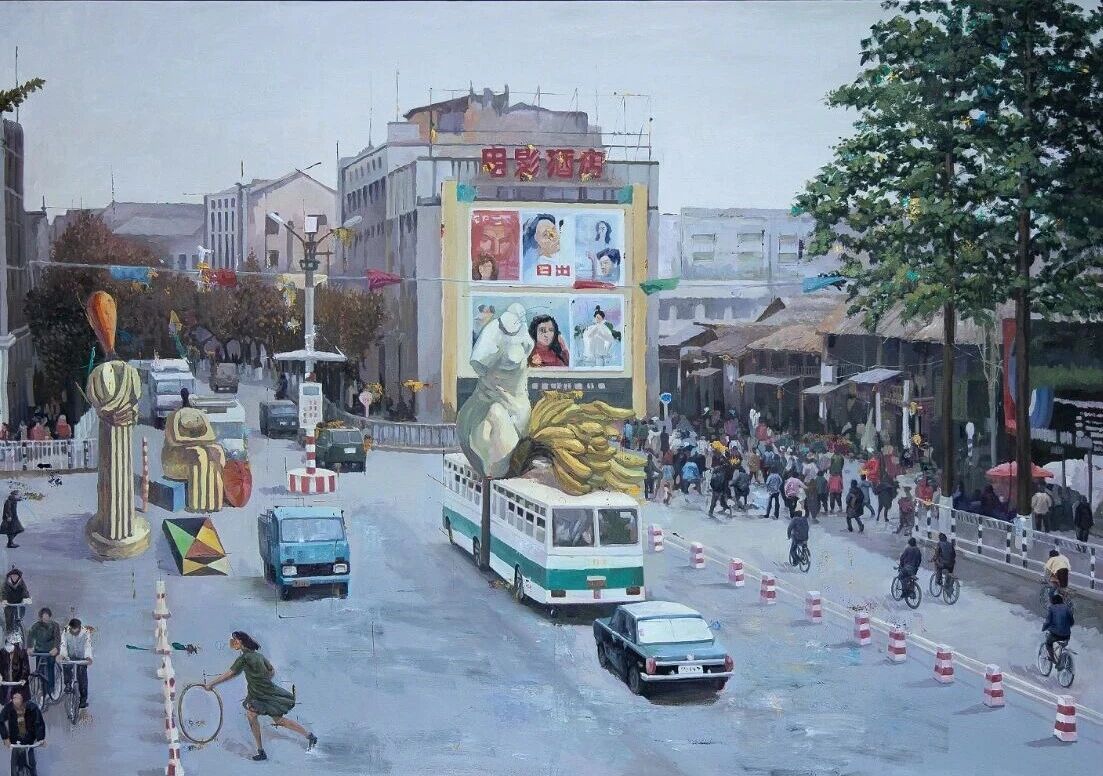
Life Props,2021-2022,Oil on canvas,200×140 cm
Returning to the exhibition itself, by titling it Blind Spot, the artist is essentially "showing his hand."
"To display my painting process, or thought process, to the audience as fully as possible; to reveal the 'blind spot' that artists most wish to conceal, and to expose the softest elements within that zone"—this is the artist's objective.
Zhang Zhaoying reconstructs his cramped studio by "folding" it into the space, placing objects from his life and work—anything potentially linked to his inspiration—within the exhibition hall. Through a form of undirected personal monologue, texts that seem "unrelated" to the works are pasted in corners, engaging in a silent dialogue with the paintings in the space.
The artist books on display, currently being leafed through, also speak to us in silence, narrating a creative process of continuous layering, deletion, and concealment. Zhang Zhaoying hopes that by his own temporary absence, he allows the audience to return to the exhibition site with a greater sense of intimacy.
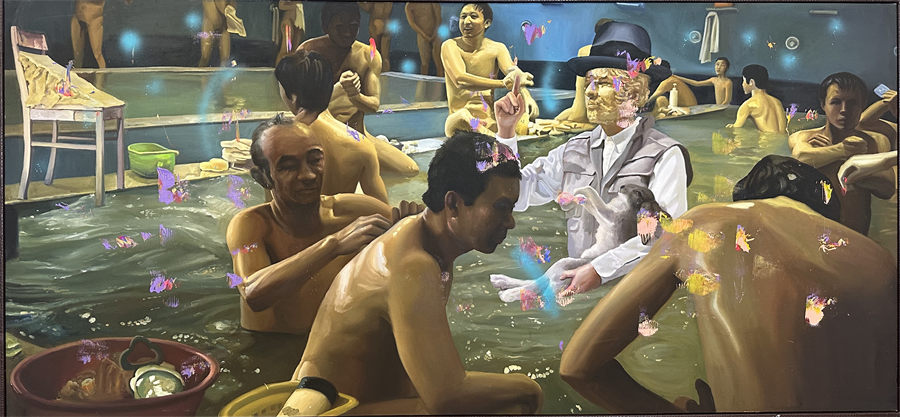
Rabbit, Bathhouse, Art History,2021-2022,Oil on canvas,200×100 cm
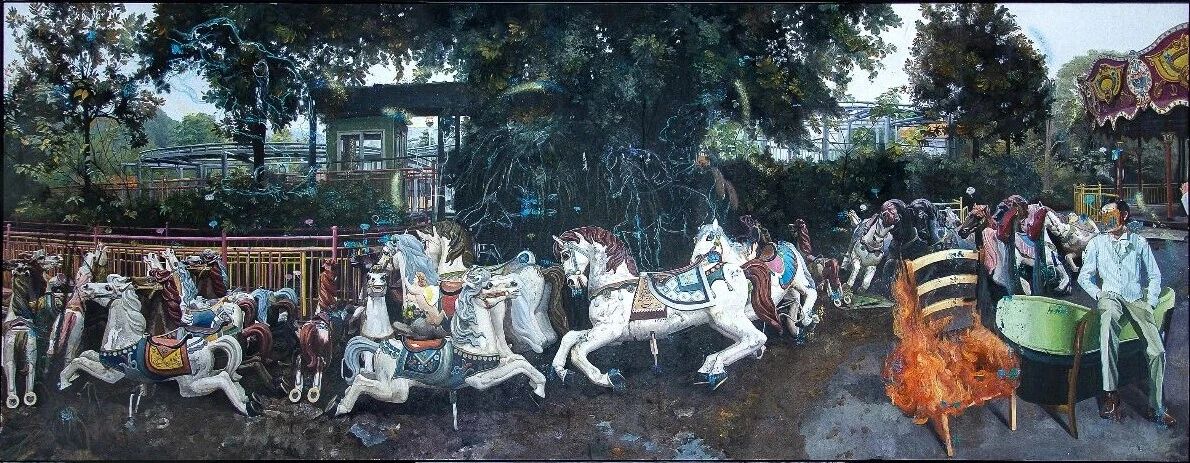
Life Props-A Scene of Horses Galloping,2021-2022,Oil on canvas,400×150 cm
Interestingly, in the process of writing this text, I scrolled through my social media feed and came across a repost of a passage from E.H. Gombrich’s The Story of Art: "Whenever a thing is done so incomparably well that we almost forget to ask what its purpose is, for the sheer admiration of the way it is done, we speak of art."
This brought to mind Zhang Zhaoying’s decision to absent himself. Everything he wishes to convey has been placed within this space, without reservation. There is no longer a need to solemnly discuss the intentions associated with the work. Perhaps this is precisely Zhang Zhaoying’s personal method of dissolving the "blind spot."


